Rwanda is turning to technology-enabled learning to help workers and young people keep pace with a labor market being reshaped by artificial intelligence, automation and rapidly changing digital skills.
The shift was at the center of the September edition of EdTech Mondays Rwanda, which brought together government, skills-development and technology-sector representatives to examine how lifelong learning can better prepare the country’s workforce for the future of work.

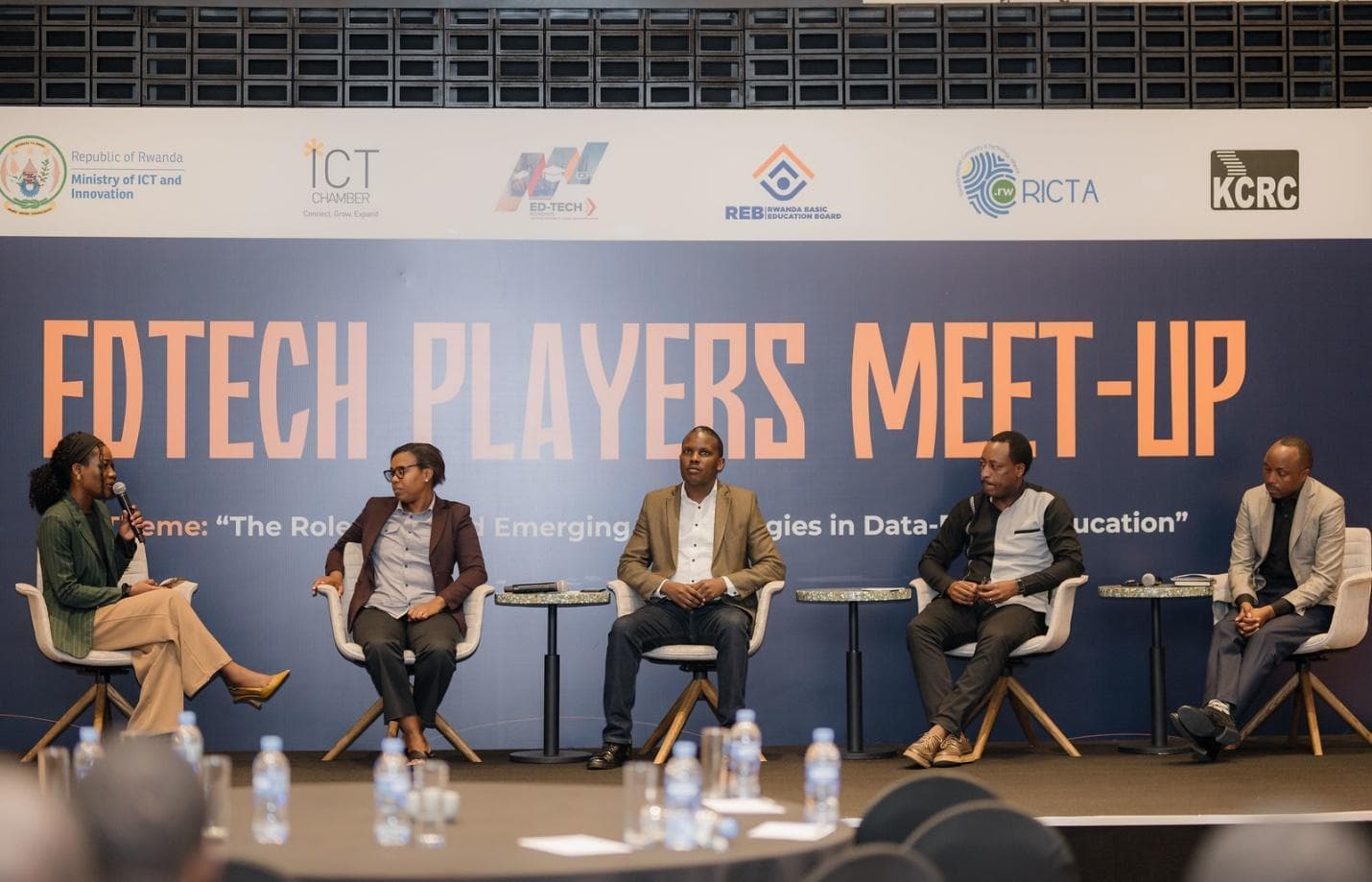
Panelists and the host of the September edition of EdTech Mondays Rwanda at KT Radio.
Marie Grace Niewumuiza of the Ministry of ICT and Innovation, Calvin Ganza of The Gym software development trainee program and Vivens Uwizeyimana, founder and CEO of Competence by Jobra, discussed the growing gap between formal education and the skills increasingly demanded by employers.

Marie Grace Niewumuiza of the Ministry of ICT and Innovation speaks on aligning digital skills development with labor-market needs.
“We teach trainees how to learn through practice and deep research, giving them the skills to adapt to new technologies,” Ganza said. “We combine strong software fundamentals with specialized training aligned to the skills the market demands.”
The comments underscore a broader challenge facing education systems as technology changes faster than traditional curricula. Rwanda’s universities and training institutions are increasingly expected not only to prepare students for their first jobs, but also to equip them with the ability to keep learning as industries evolve.
The September discussion focused on the need to make that process continuous. Digital learning platforms, online courses, mobile applications and technology-enabled training can allow people to acquire new competencies while studying, working, changing careers or building businesses, according to the concept for the discussion.

Calvin Ganza of The Gym software development trainee program highlights practice-based learning that prepares trainees to adapt to new technologies.
For government, the challenge extends beyond expanding access to technology. It also involves ensuring that digital skills development responds to actual labor-market needs and reaches people already in employment.
As artificial intelligence and other emerging technologies reshape workplaces, Rwanda needs to identify the skills that should be prioritized and strengthen cooperation between government, education institutions and the private sector, the discussion highlighted.
For EdTech companies, the opportunity is to build solutions that directly address those skills gaps rather than operate separately from employers and education institutions.
“Competence by Jobra is helping scale skills development for the future of work,” Uwizeyimana said, highlighting the role technology companies can play in connecting learning with changing workforce requirements.

Vivens Uwizeyimana, founder and CEO of Competence by Jobra, discusses how EdTech companies can help workers reskill and upskill.
That connection is becoming increasingly important as employers seek workers who can adapt beyond the skills acquired through formal schooling. The September discussion examined how EdTech companies can help workers and entrepreneurs reskill and upskill as technology transforms industries, while also strengthening links between universities, government and industry.
The discussions point to a shift in how workforce development is viewed: education is no longer confined to the years spent in school or university, but increasingly extends throughout a person’s working life.
For Rwanda, that creates both an opportunity and a policy challenge as the country pursues a knowledge-based, digitally enabled economy. Stronger links between higher education, technology innovators, employers and the wider private sector will be needed to ensure that learning translates into relevant skills, employment and entrepreneurship.
EdTech Mondays Rwanda, a joint initiative of the Mastercard Foundation and the Rwanda ICT Chamber, provides a platform for policymakers, educators, innovators and other stakeholders to debate how technology can strengthen the country’s education ecosystem.